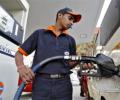
This is perhaps the first time that retail prices in India are higher than the global rates

India's crude oil imports from Russia saw a marginal decline in September, but continued to account for over one-third of the country's total oil purchases, despite US pressure to curb the trade over concerns that it supports Moscow's war effort in Ukraine. India's crude imports in September were around 4.7 million barrels per day, up 220,000 bpd month-on-month and flat year-on-year.

'Sometimes I wonder whether the meeting really happened. Everything seems like a dream from which I do not want to wake up.'

Customers have started to factor in the narrowing gap between petrol and diesel and the premium that needs to be paid for a diesel vehicle.
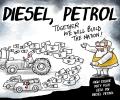
Dominic Xavier offers his take on the latest blow to personal finances.

While the Syros shines in many areas, its ride quality is a point of contention, notes Rajesh Karkera.

At one end the petrol motors have been criticised for consuming high fuel while on the other the diesel motors have also been condemned for being noisy and low powered.

While the share of diesel vehicles sales in the overall passenger car industry has already fallen sharply, sales of CNG vehicles have shown a compound annual growth rate of 15.5 per cent over the past five years.

Banks are receiving requests for cancellation of approved car loans, in view of the implementation of GST rate cut, which will lower the price of passenger vehicles and also lead to subsequent reduction in the amount needed to purchase them. It is to be noted that the 56th GST Council meeting earlier this month, approved substantial reduction in the GST rate for cars for up to 1,200 cc to 18 per cent from the existing 28 per cent.

Cement manufacturers have hiked prices after a challenging Q1FY25, and Q2FY25 (so far) when general elections and seasonal factors cut down on construction activity. The August prices are currently around 3-6 per cent above July 2024 but may not be sustainable in the face of weak demand. H2FY25 may see realisation growth which, if it happens, would drive average operating profit/tonne improvements in H2FY25 over a muted H1FY25.

Since August, petrol price has been cumulatively cut by Rs 9.36 per litre.

Jet fuel prices on Wednesday were hiked by over 18 per cent -- the steepest ever increase -- to all-time high levels after international oil price surged to a multi-year high.

Lower fuel subsidy payouts might restrict gross fiscal deficit in FY15.

Petrol and diesel price on Sunday was hiked again by 35 paise a litre and the auto fuels now cost a third more than the rate at which ATF is sold to airlines. The fourth straight day of 35 paise per litre hike sent petrol and diesel rates to record highs across the country. The price of petrol in Delhi rose to its highest-ever level of Rs 105.84 a litre and Rs 111.77 per litre in Mumbai, according to a price notification of state-owned fuel retailers.
Under-recovery or the gap between retail selling price and the cost of import, this month dipped to an all-time low of 8 paise a litre, helped by the monthly increases and softening in international oil rates.

Jet fuel prices on Monday were hiked by a steep 5.3 per cent - the tenth straight increase this year -- to an all-time high, in line with a surge in global energy prices. The price of aviation turbine fuel (ATF) -- the fuel that helps aeroplanes fly -- was hiked by Rs 6,188.25 per kilolitre, or 5.29 per cent, to Rs 1,23,039.71 per kl (Rs 123 per litre) in the national capital, according to a price notification of state-owned fuel retailers. This is the 10th straight increase in jet fuel prices this year.

Petrol price was hiked by 30 paise per litre and diesel by 35 paise a litre, according to a price notification of state-owned fuel retailers. The seventh straight day of price hike pushed fuel rates to a new record high. The price of petrol in Delhi rose to its highest-ever level of Rs 104.44 a litre and Rs 110.41 per litre in Mumbai, the notification showed. In Mumbai, diesel now comes for Rs 101.03 a litre; while in Delhi, it costs Rs 93.17.
The government has cut petrol price by Rs 5 and diesel by 2 a litre with effect from midnight tonight.
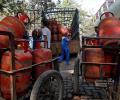
The government is likely to give a subsidy of Rs 30,000-35,000 crore to state-run oil companies - Indian Oil Corporation (IOC), Bharat Petroleum (BPCL), and Hindustan Petroleum (HPCL) - to compensate for losses incurred from selling LPG at below cost over the past 15 months, according to a senior official.
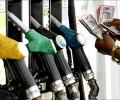
Petrol price cut by 50 paisa a litre; diesel by 46 paisa.
The government had, on June 25, freed petrol price from its control resulting in a hike of Rs 3.50 per litre.

A decision on raising diesel prices by Rs 3-5 per litre, kerosene by Rs 2 and LPG by up to Rs 50 per cylinder will be taken after UPA Chairperson Sonia Gandhi returns from US, top government officials said.

OMCs are currently incurring daily under-recovery of Rs 230 crore.

Additionally, road cess on petrol was raised by Re 1 per litre each on petrol and diesel to Rs 10.
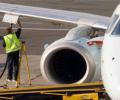
It is the seventh reduction in jet fuel rates since August
From just 0.2 per cent before the Russia-Ukraine war to now accounting for 35-40 per cent of total crude imports, India's reliance on Russian oil has surged -- drawing fresh scrutiny with US President Donald Trump announcing a penalty on top of a 25 per cent tariff, or tax, on all goods going to the US.
Union Minister Nityanand Rai launched a scathing attack on Congress, stating that the party takes "pleasure" in insulting Bihar and its people.

Diesel price needs to be revised upward, or subjected to higher taxes, as misuse of subsidized diesel was adding to pollution and public health costs, the government's pre-budget economic report card said on Thursday.
Diesel price needs to be revised upward, or subjected to higher taxes, as misuse of subsidized diesel was adding to pollution and public health costs, the government's pre-budget economic report card said on Thursday.

With Brent crude oil prices dipping below $100 per barrel, petrol prices may be cut by Re 1 a litre and there is also a likelihood of first reduction in diesel rates in seven years.

Tata Motors on Tuesday said it has reduced prices of its electric vehicle model range by up to Rs 3 lakh. The Mumbai-based automaker said it has reduced the price of Nexon EV by up to Rs 3 lakh, Punch EV by 1.2 lakh, and Tiago EV by Rs 40,000.

Petrol price was on Wednesday hiked by a steep Rs 3.38 per litre and diesel by Rs 2.67 a litre, reversing a two-month declining trend.
However, it may still not change its stance on the policy rate as inflationary pressures are coming from high commodity prices.
Normal or unbranded diesel currently attracts basic excise duty of Rs 1.46 a litre and an additional excise duty of Rs 2 per litre.

Government-controlled oil-marketing companies (OMCs) have held back petrol and diesel price revisions for a week and are expected to continue doing so, ostensibly owing to political reasons. It appears that the Centre has informally conveyed to the three major OMCs to not revise fuel prices for the time being, two people in the government said. This informal directive follows the talks between the Centre and states on cutting taxes and bringing the auto fuels under the good service tax regime not fetching the desired results, so far.

General Motors India Vice President P Balendran termed the decision as a positive move for the overall economy.
Petrol and diesel price soared to an all-time high across the country on Friday after rates were hiked again by 25 paise and 30 paise a litre, respectively. The price of petrol in Delhi rose it its highest ever level of Rs 101.89 a litre and to Rs 107.95 in Mumbai, according to a price notification of state-owned fuel retailers. Diesel rates too touched a record high of Rs 90.17 in Delhi and Rs 97.84 in Mumbai.

In 2010, the govt had taken an "in-principle" decision to deregulate diesel prices, but could not implement it due to political pressure.

Jet fuel (ATF) price was on Monday hiked by a steep 56.5 per cent and that of non-subsidised cooking gas LPG by Rs 11.5 per cylinder on the back of firming up of international oil rates, but petrol and diesel prices continued to remain on freeze for a record 78th day. Aviation turbine fuel (ATF) price was hiked by Rs 12,126.75 per kilolitre (kl), or 56.5 per cent, to Rs 33,575.37 per kl in the national capital, according to a price notification by State-owned oil marketing companies.

'In the luxury car segment, the adoption of EVs is almost double compared to the mass market.'
